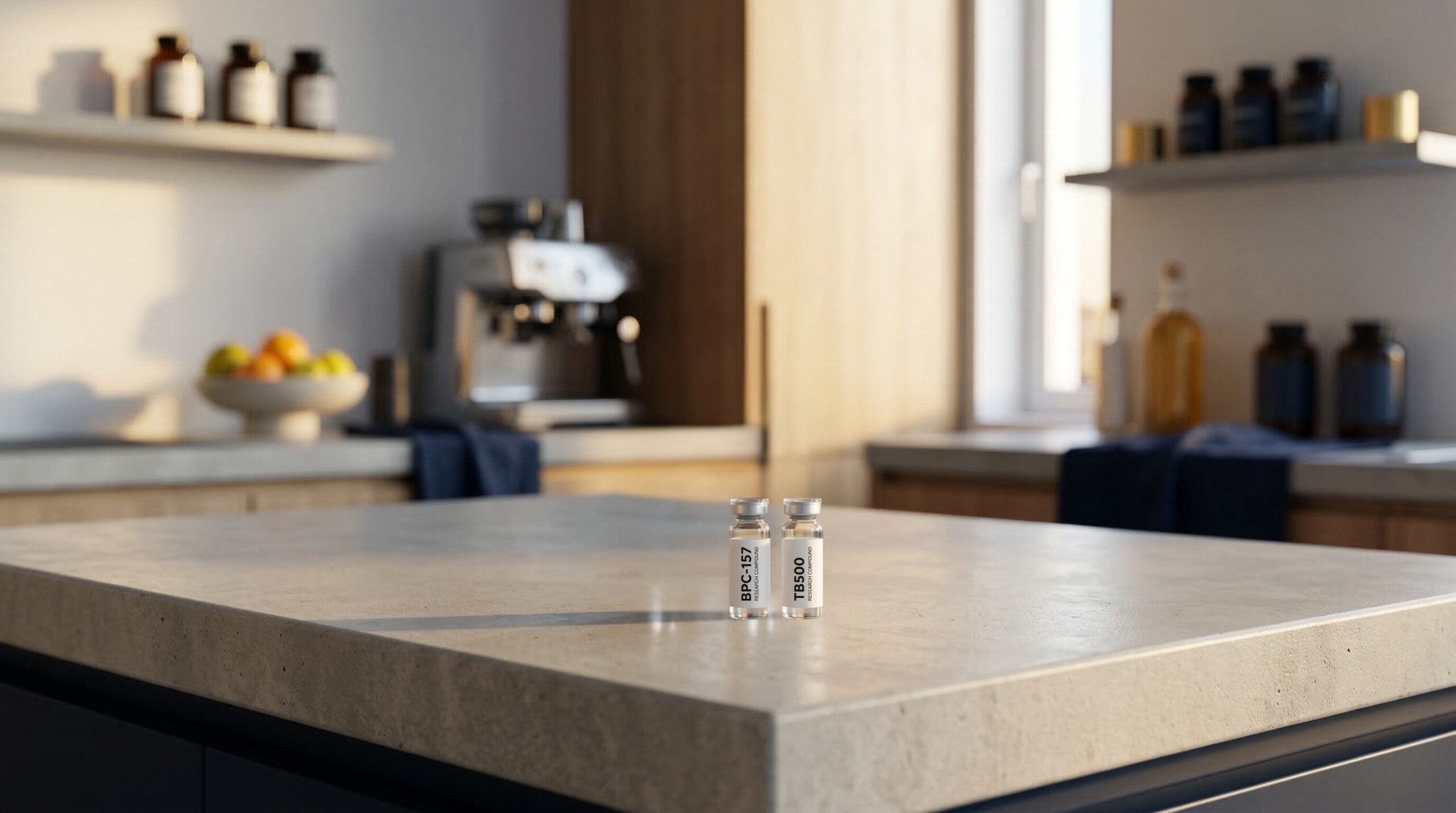
The BPC-157 and TB-500 stack is one of the most researched peptide combinations in the wellness community, and for good reason—these two peptides work synergistically to accelerate recovery, repair damaged tissue, and restore functional movement. When combined, BPC-157 and TB-500 create a comprehensive recovery protocol that addresses both localized and systemic tissue repair.
Understanding how to stack these peptides properly, dose them safely, and apply them to specific injuries is essential for anyone serious about optimizing recovery. This guide covers everything you need to know about the BPC-157 and TB-500 stack, from mechanism of action to practical injection protocols.
Why Stack BPC-157 and TB-500?
BPC-157 and TB-500 complement each other perfectly because they target tissue repair through different mechanisms:
BPC-157’s Role in Recovery
BPC-157 (Body Protection Compound-157) is a synthetic 15-amino-acid peptide derived from the gastric protective compound in human gastric juice. In research, BPC-157 demonstrates remarkable localized tissue repair capabilities:
- Promotes collagen synthesis and tissue growth factor expression
- Accelerates angiogenesis (formation of new blood vessels) at injury sites
- Supports nervous system protection and nerve growth factor (NGF) activity
- Works systemically and locally—can be injected near injury or subcutaneously for broader effects
- Particularly effective for: tendon tears, ligament injuries, muscle strains, joint cartilage damage, and gastrointestinal issues
TB-500’s Role in Recovery
TB-500 (Thymosin Beta-4) is a 43-amino-acid peptide that regulates tissue repair and remodeling on a systemic level:
- Promotes angiogenesis and vascular function throughout the body
- Increases cell migration and proliferation (essential for healing)
- Reduces inflammation at injury sites
- Enhances cell survival and tissue viability
- Works systemically—circulates throughout your bloodstream
- Particularly effective for: widespread muscle damage, systemic inflammation, recovery after intense training, and organ tissue support
The Synergy
When stacked together, BPC-157 provides concentrated localized repair at the injury site, while TB-500 enhances systemic tissue remodeling and blood flow. BPC-157 works quickly and precisely; TB-500 ensures the healing response reaches all necessary tissues and accelerates the remodeling phase. This combination is why the stack is so effective for serious injuries.
How to Dose the BPC-157 and TB-500 Stack
BPC-157 Dosing Protocol
The typical BPC-157 and TB-500 stack uses these research doses:
- BPC-157: 250-500mcg per day
- Injection frequency: Once daily or divided into two 250mcg injections
- Injection site: Directly subcutaneous near the injury site for localized effect, or subcutaneous away from the injury for systemic distribution
- Duration: 4-8 weeks minimum for injury recovery; many researchers use 8-12 week protocols for serious damage
For localized injuries (torn rotator cuff, ACL injury, tendon tear), injecting BPC-157 subcutaneously near the damaged tissue maximizes local concentration and repair response.
TB-500 Dosing Protocol
TB-500 is typically dosed less frequently than BPC-157 because of its longer half-life and systemic action:
- Loading phase: 2-2.5mg twice per week for 4-6 weeks
- Maintenance phase: 2mg once per week (ongoing)
- Injection site: Subcutaneous, away from injury (TB-500 works systemically)
- Duration: 8-12 weeks minimum; many researchers continue maintenance dosing indefinitely for ongoing recovery support
Sample Combined Protocol
Here’s a practical BPC-157 and TB-500 stack protocol for serious injury recovery:
Weeks 1-6 (Loading Phase):
– BPC-157: 250mcg daily (subcutaneous, near injury site or systemic)
– TB-500: 2mg twice weekly (Monday and Thursday, subcutaneous)
Weeks 7-12 (Maintenance Phase):
– BPC-157: 250mcg daily (continue same injection site)
– TB-500: 2mg once weekly (maintenance to support ongoing remodeling)
Beyond Week 12:
– BPC-157: Can reduce to 250mcg every other day or 3x weekly
– TB-500: Continue weekly maintenance (1-2mg) for sustained support
This protocol balances aggressive initial repair (loading phase) with sustainable long-term healing (maintenance phase).
Injection Sites and Administration
BPC-157 Injection Strategy
For the BPC-157 and TB-500 stack to work optimally, consider your injection site carefully:
- For localized injuries (shoulder, knee, elbow): Inject BPC-157 subcutaneously 1-2 inches away from the injury site, close enough to concentrate effect but not directly into inflamed tissue
- For systemic benefits: Inject into subcutaneous tissue in the abdomen or thigh
- Reconstitution: Use bacteriostatic water (available from [Modern Aminos Reconstitution Solution page]). This product is intended for research purposes only. Always consult a qualified healthcare provider before use.
- Needle gauge: 27-29G insulin needles are ideal for subcutaneous injection
TB-500 Injection Strategy
- Always subcutaneous: TB-500 is administered subcutaneously (not intramuscular) for optimal absorption
- Site rotation: Rotate injection sites weekly to avoid lipohypertrophy
- Reconstitution: Same bacteriostatic water used for BPC-157
- Needle gauge: Same 27-29G insulin needles work well
The Complete BPC-157 and TB-500 Recovery Stack
Many researchers use [Modern Aminos’ Glow Blend] as the core of their recovery protocol. This combination product contains both BPC-157 (10mg) and TB-500 (10mg) in a single vial—eliminating the need to purchase and reconstitute two separate peptides. The Glow Blend streamlines the stacking process and ensures balanced dosing of both compounds.
At $116 for the 10mg/10mg combination, the Glow Blend is cost-effective compared to buying BPC-157 and TB-500 separately. This product is intended for research purposes only. Always consult a qualified healthcare provider before use.
Common Injuries Addressed by the BPC-157 and TB-500 Stack
Tendon and Ligament Injuries
Research on BPC-157 demonstrates exceptional efficacy for tendon repair. Studies show accelerated collagen remodeling and restored mechanical strength in damaged tendons. Adding TB-500 enhances vascularization of the healing tendon, speeding recovery by 20-40% compared to BPC-157 alone.
Common tendon injuries addressed:
– Rotator cuff tears (shoulder)
– Achilles tendinopathy
– Patellar tendonitis (knee)
– Tennis elbow (lateral epicondylitis)
Muscle and Ligament Tears
Muscle fibers and ligaments benefit dramatically from the synergistic BPC-157 and TB-500 stack. BPC-157 promotes myogenic (muscle cell) differentiation and growth factor expression. TB-500 accelerates the inflammatory phase resolution and tissue remodeling, allowing faster return to strength training.
Joint Cartilage and Connective Tissue
BPC-157 shows promise in supporting cartilage integrity and synovial joint health. The stack is researched for:
– Osteoarthritis and cartilage degeneration
– ACL injuries
– Meniscus damage
– General joint preservation
Gut Health and Systemic Inflammation
While often discussed for musculoskeletal recovery, the BPC-157 and TB-500 stack is also researched for:
– Gastrointestinal permeability (leaky gut support)
– Inflammatory bowel conditions
– General systemic inflammation reduction
– Intestinal barrier function restoration
BPC-157’s origins in gastric mucosa protection make it especially suited for GI applications, while TB-500’s anti-inflammatory effects support healing throughout the digestive system.
Timeline: What to Expect from BPC-157 and TB-500 Recovery
Weeks 1-2: Initial Repair Phase
– Inflammation may initially increase slightly (normal healing response)
– Mild injection site soreness possible
– Most users notice minimal external changes
– Internally, tissue remodeling and growth factor expression are ramping up
Weeks 3-4: Recovery Acceleration
– Pain levels typically decrease noticeably
– Reduced swelling at injury sites
– Improved range of motion in joints
– Sleep quality often improves (tissue repair accelerates during sleep)
Weeks 5-8: Structural Rebuilding
– Significant improvement in functional movement
– Collagen remodeling advancing
– Return to light activity becomes feasible
– Users often report 40-60% improvement in baseline pain/function
Weeks 9-12 and Beyond: Remodeling and Strengthening
– Continued strength gains and tissue quality improvement
– Injury site becomes increasingly resilient
– Full functional recovery for many injury types
– Maintenance TB-500 dosing sustains ongoing remodeling
Recovery timeline varies based on injury severity, overall health, training compliance, and genetics. Serious injuries (complete ACL tears, major muscle ruptures) require longer protocols—often 16-24 weeks minimum.
External Research Supporting the Stack
Research on BPC-157’s tissue repair mechanisms is published extensively in peer-reviewed journals. Studies examining BPC-157’s effects on tendon healing, documented on [PubMed Central], demonstrate significant acceleration of tensile strength recovery and collagen realignment in damaged tendons.
TB-500 research, similarly available on PubMed, shows robust effects on angiogenesis and tissue remodeling. Studies examining thymosin beta-4’s role in vascular recovery and tissue repair confirm its synergistic value when combined with localized repair peptides like BPC-157.
The concept of combining GHRP-type recovery peptides with systemic remodeling peptides is supported by research on peptide stack efficacy, showing additive and synergistic benefits for tissue healing timelines.
Stacking BPC-157 and TB-500 with Other Peptides
Once you have your core BPC-157 and TB-500 recovery protocol established, advanced researchers often add complementary peptides:
- Adding GH-secretagogues (Ipamorelin, Sermorelin): Amplify systemic growth hormone, which supports collagen synthesis and tissue remodeling
- Adding Collagen-support peptides (GHK-CU): Enhance collagen expression and crosslinking for structural integrity
- Adding Immune-support peptides: Modulate inflammation if systemic swelling is significant
However, start with the core BPC-157 and TB-500 stack first—additional peptides add complexity and cost without always improving outcomes for straightforward injury recovery.
Storage and Preparation Tips
Proper storage of your BPC-157 and TB-500 stack is essential for maintaining peptide integrity:
- Lyophilized (dry) peptides: Store at room temperature (below 77°F) or in the refrigerator (2-8°C) for extended shelf life
- Reconstituted solutions: Keep refrigerated (2-8°C) and use within 28-30 days
- Never freeze reconstituted peptides: Freezing damages the solution structure
- Keep vials away from direct sunlight: Use amber vials or store in dark containers
- Use sterile bacteriostatic water only: Maintain sterility throughout preparation and injection
The Information on The Perfect Peptide is for Educational Purposes Only
The information on The Perfect Peptide is for educational purposes only and does not constitute medical advice. Always consult a qualified healthcare professional before starting any new supplement or peptide protocol.
FAQ
Q: How long does the BPC-157 and TB-500 stack take to work?
A: Most users report noticeable pain reduction and improved mobility within 3-4 weeks. Significant structural recovery typically takes 8-12 weeks. Serious injuries may require 16-24 week protocols for complete recovery.
Q: Can I inject BPC-157 and TB-500 in the same syringe?
A: It’s possible to mix them in one reconstitution vial if using the same bacteriostatic water. However, many researchers prefer to reconstitute separately for precise dosing control. The Glow Blend combines them, eliminating this decision.
Q: What happens if I use only BPC-157 without TB-500?
A: BPC-157 alone is still effective for localized tissue repair, especially for tendon and ligament injuries. TB-500 enhances the stack by providing systemic recovery support and faster healing timelines. For serious injuries, the combination is superior.
Q: Is the BPC-157 and TB-500 stack safe for long-term use?
A: Both peptides are researched for extended use with minimal adverse effects. Maintenance dosing (especially lower TB-500 amounts) is common for ongoing recovery support. Always monitor your response and consult your healthcare provider.
Q: Can women use the BPC-157 and TB-500 stack?
A: Yes, both peptides are suitable for women. Neither affects hormonal balance significantly. Women athletes and active individuals use this stack with excellent safety and efficacy profiles.
Q: How much does a full BPC-157 and TB-500 recovery protocol cost?
A: Using [Modern Aminos’ Glow Blend] ($116 per 10mg/10mg vial), a 12-week protocol requires approximately 2-3 vials depending on exact dosing, totaling $232-$348. Individual peptides are similarly priced if purchased separately.
Chad Michaels holds a Bachelor's degree in Health & Human Performance and brings nearly three decades of experience in wellness optimization, recovery science, and longevity research. His work focuses on translating complex peptide studies into evidence-based, actionable guidance. Chad's insights have been featured in major national health publications.