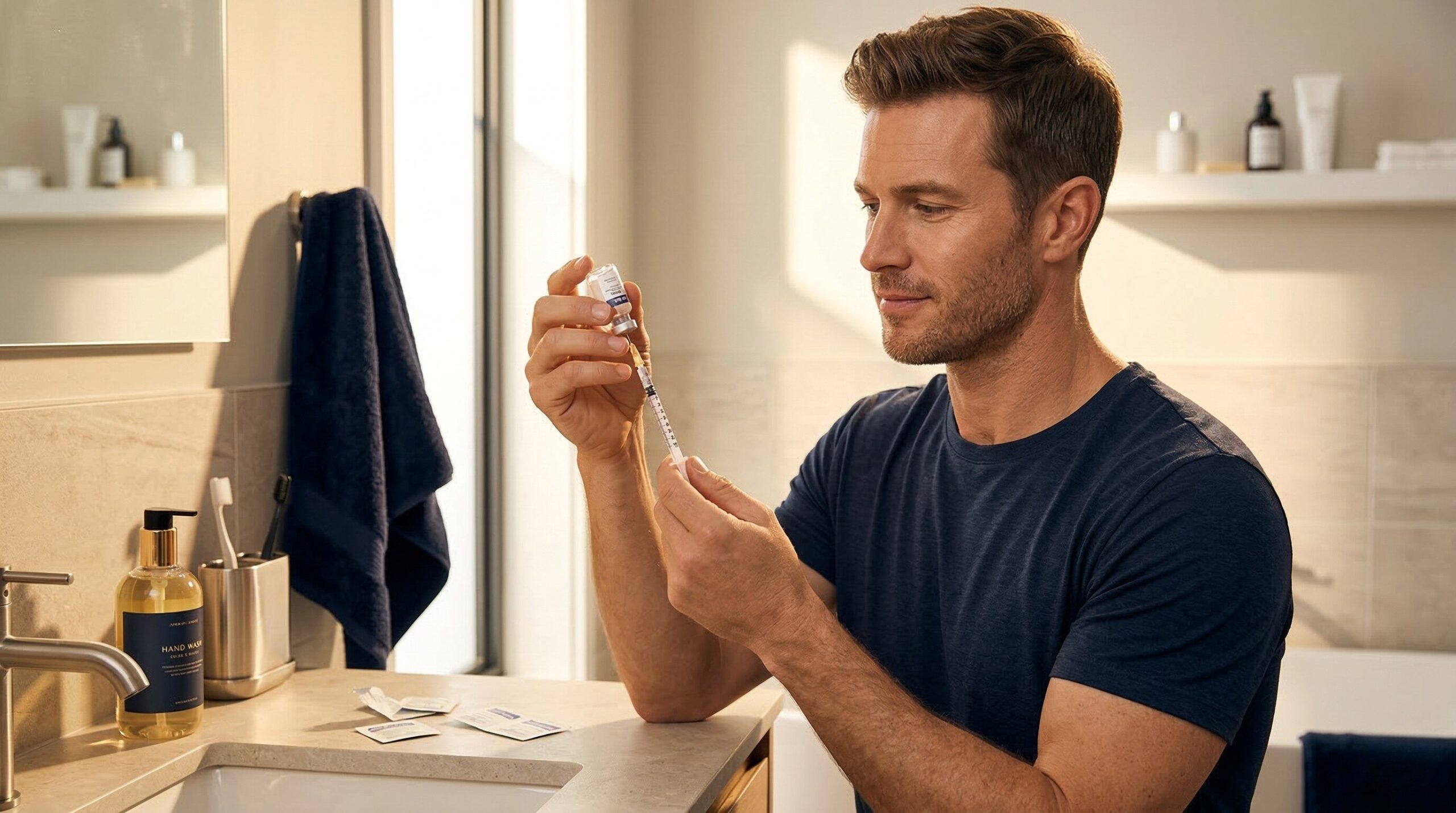
Learning how to inject peptides properly is essential for anyone serious about research protocols. Whether you’re using subcutaneous or intramuscular injection methods, mastering the fundamentals ensures safety, consistency, and better results. This guide walks you through every step, from gathering supplies to proper site rotation and troubleshooting common mistakes.
What You’ll Need: The Complete Supplies Checklist
Before you inject peptides for the first time, gather all necessary supplies. Having everything prepared prevents mistakes and keeps your protocol clean and efficient.
Essential supplies:
- Insulin syringes — 0.5-inch needles, 29-31 gauge (the smaller the gauge number, the thicker the needle; 29-31g is ideal for peptide research)
- Bacteriostatic water — for reconstitution if your peptide arrives as powder; Modern Aminos’s Bacteriostatic Water comes in 10mL ($14.99) and 30mL ($18.99) options
- Alcohol prep pads — 70% isopropyl alcohol to sterilize injection sites and vial stoppers
- Sharps disposal container — critical for safe needle disposal; prevents accidental needlestick injuries
- Peptide vials with rubber stoppers — ensure they arrive from a reputable research supplier like Modern Aminos
- [Amazon: insulin syringes 29g] — reliable source for bulk syringes if needed
- [Amazon: alcohol prep pads] — economical packs for consistent sterilization
- [Amazon: sharps disposal container] — complies with biohazard disposal standards
Having sterile, quality supplies eliminates a major source of infection risk. Never reuse needles, and always use fresh alcohol pads for each injection site.
Subcutaneous vs. Intramuscular Injection: Which One for Peptides?
Understanding the difference between subcutaneous (SubQ) and intramuscular (IM) injection is crucial. Most research peptides are administered subcutaneously, but knowing both methods ensures you’re using the right technique for your protocol.
| Feature | Subcutaneous (SubQ) | Intramuscular (IM) |
|---|---|---|
| Injection depth | Into fat layer (adipose tissue) below skin | Directly into muscle belly |
| Needle angle | 45 degrees | 90 degrees (perpendicular) |
| Needle length | 0.5 inch (standard) | 0.5–1 inch |
| Absorption rate | Slower, more sustained release | Faster initial absorption |
| Common peptide use | Most research peptides (BPC-157, TB-500, growth hormone releasing peptides) | Less common; some prefer for larger volumes |
| Pain level | Minimal; far fewer nerve endings in fat | Slightly more; muscle is innervated |
| Site rotation | Easier; more injection sites available | Fewer usable sites |
| Risk of lipodystrophy | Higher if sites aren’t rotated | Lower due to fewer repeated injections |
For most research peptides, subcutaneous injection is the standard. It’s gentler, requires less skill, and works exceptionally well for peptide protocols. SubQ absorption is steady and predictable, making it ideal for dosing consistency.
How to Inject Peptides: The 12-Step Protocol
This step-by-step process covers the most common subcutaneous injection method. Follow each step carefully to ensure sterility and proper delivery.
Step 1: Wash Your Hands
Thoroughly wash your hands with soap and warm water for at least 20 seconds. This removes bacteria and prevents contamination of sterile supplies.
Step 2: Prepare Your Workspace
Clear a clean, flat surface (kitchen counter or bathroom). Lay out all supplies where you can see them. Good lighting prevents mistakes.
Step 3: Inspect Your Peptide Vial
Check the vial for cracks, cloudiness, or visible contamination. The solution should be clear. If you’re using reconstituted peptide, verify that the powder has fully dissolved (see our guide on how to reconstitute peptides if needed).
Step 4: Sterilize the Vial Stopper
Wipe the rubber stopper on your peptide vial with an alcohol prep pad. Use a circular motion for 10-15 seconds and let it air dry for 10 seconds. This kills bacteria on the vial’s surface.
Step 5: Draw Air Into the Syringe
Pull back the syringe plunger to draw in an amount of air equal to the dose you’re about to inject. For example, if you’re injecting 100mcg, draw 0.01mL of air. This prevents a vacuum inside the vial when you draw your peptide.
Step 6: Inject Air Into the Vial
Insert the needle through the sterilized rubber stopper at a slight angle. Inject the air into the vial to equalize pressure. This makes drawing your dose much easier.
Step 7: Invert the Vial and Draw Your Dose
Turn the vial upside down (needle still inserted), and slowly pull back the plunger to draw your calculated dose. Draw slightly more than needed; you’ll expel bubbles next.
Step 8: Remove Air Bubbles
Hold the syringe upright with the needle pointing up. Tap the barrel gently to make bubbles rise to the top. Push the plunger to expel air back into the vial, and redraw to the correct dose line.
Step 9: Remove the Needle from the Vial
Carefully withdraw the needle and set the vial down. Keep the loaded syringe pointing upward to prevent accidental drips.
Step 10: Select and Prepare Your Injection Site
Choose a rotation site (see injection sites section below). Clean the skin with an alcohol prep pad using a circular motion. Let it air dry for 10-15 seconds — injecting through wet alcohol can sting and may reduce effectiveness.
Step 11: Perform the Injection
Pinch the skin gently (SubQ requires a slight pinch to ensure you’re injecting into the fat layer). Insert the needle at a 45-degree angle with one smooth motion. Once the needle is fully inserted, release the pinch and slowly inject the peptide over 3-5 seconds. A slow injection is less painful and allows better diffusion.
Step 12: Withdraw and Dispose Safely
Remove the needle with one smooth motion. Apply gentle pressure to the injection site with a fresh alcohol pad for 10 seconds. Do not massage the area; this can cause bruising. Immediately place the used needle in your sharps container.
Common Subcutaneous Injection Sites for Peptides
Rotating injection sites is absolutely critical. Repeated injections in the same spot cause lipodystrophy — a hardening and thickening of fatty tissue that reduces absorption and increases infection risk.
Primary injection sites:
- Abdomen — 2 inches to either side of your navel (avoid the navel itself and any scars). This is the most common peptide injection site due to ease of access and large usable area.
- Outer thigh — the area between hip and knee, outer (lateral) side. Equally effective and easy to reach.
- Upper arm (back of tricep) — the area on the back of your upper arm, below the shoulder. Slightly less common but viable.
- Love handles — the area above the hip on the side of your torso. Often overlooked but offers a large rotation area.
Rotation strategy: If injecting daily or every other day, maintain a log of which site you used and when. Aim to not repeat the exact same spot more than once every 7-10 days. For example:
– Day 1: Abdomen, right side
– Day 2: Abdomen, left side
– Day 3: Outer thigh, right
– Day 4: Outer thigh, left
– Day 5: Upper arm, right
– Day 6: Upper arm, left
Then restart the cycle. This simple approach prevents lipodystrophy and ensures consistent absorption.
Hygiene Rules You Cannot Skip
Infection is the primary risk when injecting peptides. Strict hygiene prevents nearly all infection-related complications.
Non-negotiable rules:
- Never reuse needles. Even a needle that looks clean can harbor bacteria. One needle = one injection.
- Always use a fresh alcohol pad for each injection site and vial sterilization.
- Wash your hands before every injection.
- Allow alcohol to air dry before injecting (don’t blow on it). Wet alcohol can cause stinging and reduce effectiveness.
- Never touch the tip of the needle with your fingers.
- Keep peptide vials refrigerated between injections (usually 2–8°C unless manufacturer specifies otherwise). Warm vials degrade peptides and can harbor bacterial growth.
- Discard vials after 30 days even if product remains, unless the manufacturer specifies a longer window. Once a vial is opened and reconstituted, bacterial contamination risk increases over time.
- Use only sterile water (bacteriostatic water or sterile saline). Never use tap water or distilled water without bacteriostatic agents.
Common Mistakes to Avoid
Learning from others’ mistakes accelerates your mastery of peptide injection.
Mistake 1: Not Rotating Sites
Injecting in the same spot repeatedly causes lipohypertrophy (thickened scar tissue), which reduces absorption and increases pain. Maintain a rotation log to stay consistent.
Mistake 2: Skipping the Alcohol Swab
A “quick” injection without sterilization dramatically increases infection risk. The 15-second swab is insurance against serious complications. Never skip it.
Mistake 3: Injecting a Cold Peptide
Peptides stored in the fridge can be more viscous and uncomfortable when injected cold. Let the vial sit at room temperature for 5-10 minutes before injecting (but keep this brief to avoid degradation). A room-temperature peptide injects more smoothly.
Mistake 4: Injecting Too Quickly
Pushing peptide in under a second causes pain, pressure buildup, and incomplete diffusion. Inject over 3-5 seconds for a smoother, more comfortable experience.
Mistake 5: Reusing Needles
Even if a needle looks clean, bacteria can cling to the microscopic barbs on the needle tip. One needle per injection is the only safe practice.
Mistake 6: Injecting Into Scar Tissue or Lipomas
Avoid any lumps, bruises, or hardened areas from previous injections. These indicate compromised tissue and poor absorption. Choose a fresh, smooth area.
Mistake 7: Not Checking for Proper Reconstitution
If you’re using powdered peptide, ensure it’s fully reconstituted before injecting. Cloudy or undissolved peptide can reduce efficacy and cause inflammation.
When to Consult a Healthcare Provider
While peptide injection is generally straightforward, certain warning signs require immediate medical attention.
Seek medical advice if you experience:
- Spreading redness or warmth extending more than 1 inch beyond the injection site
- Swelling, hardness, or lumps that develop over days or weeks
- Fever, chills, or systemic symptoms within 24-48 hours of injection
- Pus, drainage, or unusual discharge from the injection site
- Severe pain that doesn’t resolve within a few hours
- Allergic reactions (rash, difficulty breathing, swelling of face or lips)
- Numbness or tingling that spreads or persists
These symptoms can indicate infection, allergic reaction, or improper injection technique. A qualified healthcare provider can assess and provide appropriate treatment. Always consult a medical professional before starting any new peptide protocol, especially if you have pre-existing health conditions.
“Products mentioned in this article are intended for research purposes only. Always consult a qualified healthcare provider before use.”
FAQ: How to Inject Peptides
Q: What gauge needle should I use for peptide injection?
A: Use a 29-31 gauge needle, 0.5 inches long. This size is small enough to minimize pain but large enough to allow easy injection without clogging. Some people prefer 31 gauge for less trauma, while others find 29 gauge more convenient for thicker solutions.
Q: Can I inject intramuscularly instead of subcutaneously?
A: Yes, but subcutaneous is standard for most research peptides. Intramuscular injection works but offers no significant advantage for peptides, requires more skill, has slightly higher pain, and limits rotation sites. Stick with SubQ unless you have a specific protocol reason otherwise.
Q: How long can I store an open, reconstituted peptide vial?
A: Once reconstituted with bacteriostatic water, most peptides are stable for 30 days if refrigerated at 2–8°C. Some remain viable longer, but 30 days is the safe standard. Always check your supplier’s recommendations — Modern Aminos provides specific storage guidance with each product.
Q: What’s the best time of day to inject peptides?
A: This depends on the peptide. Growth hormone releasing peptides (like Ipamorelin or CJC-1295) work best injected 30-45 minutes before bed or pre-workout on an empty stomach. Recovery-focused peptides (like BPC-157) can be injected anytime. Check your specific peptide’s research protocol.
Q: Is it normal to see bruising after injection?
A: Minor bruising (small spots) is normal and usually resolves in 5-7 days. Large bruises may indicate injecting too quickly, using a dull needle, or hitting a small capillary. Minimize bruising by injecting slowly, using fresh needles, and rotating sites frequently.
Q: Do I need to massage the injection site after injecting?
A: No. Gentle pressure with an alcohol pad for 10 seconds is sufficient. Massaging can cause bruising and may disperse the peptide away from the intended area. For subcutaneous injections, let the peptide diffuse naturally.

Chad Michaels holds a Bachelor's degree in Health & Human Performance and brings nearly three decades of experience in wellness optimization, recovery science, and longevity research. His work focuses on translating complex peptide studies into evidence-based, actionable guidance. Chad's insights have been featured in major national health publications.