
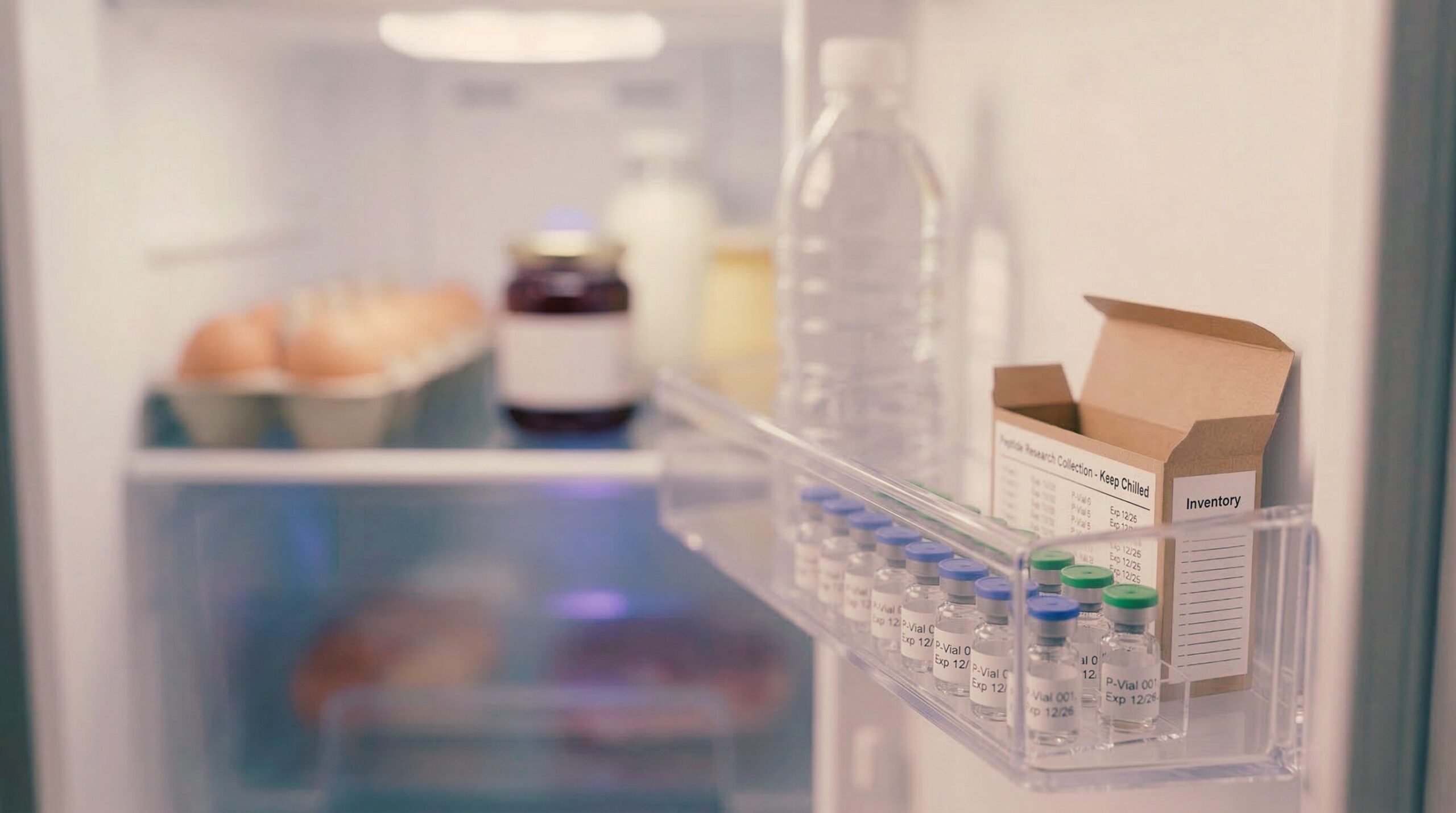
Proper peptide storage is absolutely critical for maintaining potency and ensuring your research yields reliable results. Peptides are delicate biological molecules vulnerable to degradation from heat, light, moisture, and repeated temperature fluctuations. Understanding peptide storage requirements—whether you’re working with lyophilized (freeze-dried) powder or reconstituted solutions—will save you money, protect your investment, and guarantee the integrity of your research.
This guide covers everything you need to know about peptide storage: temperature ranges, container types, shelf life expectations, and practical setup recommendations for both short-term and long-term preservation.
Understanding Peptide Chemistry and Degradation
Peptides are chains of amino acids held together by peptide bonds. These bonds are vulnerable to degradation from:
- Heat: Elevated temperatures accelerate amino acid breakdown and reduce peptide stability
- Light exposure: UV and visible light can damage peptide structures and promote oxidation
- Moisture: Water promotes hydrolysis (breakdown) of peptide bonds, especially in reconstituted solutions
- Oxygen exposure: Oxidative damage degrades amino acid side chains
- Temperature cycling: Repeated freezing and thawing creates ice crystal formation that damages molecular structure
- Bacterial contamination: Microbes in solutions consume peptides and produce metabolites that degrade purity
Controlling these variables is the core principle of peptide storage. Different peptide forms (lyophilized vs. reconstituted) have different storage requirements because they face different degradation risks.
Lyophilized (Freeze-Dried) Peptide Storage
Standard Lyophilized Peptide Storage Conditions
Lyophilized peptides come as dry powder—the water has been removed, making them significantly more stable than reconstituted solutions:
Room Temperature Storage (Short-term)
– Temperature: 59-77°F (15-25°C)
– Duration: 6-12 months typical
– Container: Original sealed vial with desiccant packet included
– Best for: Short-term storage, peptides you’ll use within 3-6 months
– Advantages: Convenient, no equipment needed
– Cautions: Avoid humid environments; keep away from direct sunlight
Refrigerator Storage (Medium-term)
– Temperature: 36-46°F (2-8°C)
– Duration: 1-2 years typical
– Container: Original sealed vial in airtight bag or container
– Best for: Most peptide research projects
– Advantages: Significantly extends shelf life; stable for extended periods
– Cautions: Keep refrigerator humidity low; avoid repeated opening of vial
Freezer Storage (Long-term)
– Temperature: -4°F to -22°C (-20°C is ideal)
– Duration: 2-5 years typical (some peptides remain viable 5-10 years)
– Container: Original sealed vial, placed in airtight freezer-safe bag or vacuum-sealed
– Best for: Peptides you want to preserve for 1+ years
– Advantages: Dramatically extends shelf life; deep freeze slows molecular degradation to near-zero
– Cautions: NEVER refreeze thawed peptides; freeze-thaw cycles destroy peptides
Ultralow Freezer Storage (Research-Grade)
– Temperature: -112°F to -148°C (-80°C typical)
– Duration: 5-10+ years
– Container: Original vial in freezer-safe container
– Best for: Long-term peptide archives; institutional research
– Advantages: Essentially indefinite stability
– Practical limitation: Most home researchers don’t have access to -80°C freezers
Reconstituted Peptide Storage
Once you’ve reconstituted your lyophilized peptide powder with bacteriostatic water or another solvent, stability drops dramatically. The aqueous solution is far more vulnerable to degradation.
Reconstituted Peptide Storage Requirements
Refrigerator Storage (Standard)
– Temperature: 36-46°F (2-8°C)
– Duration: 28-30 days typical
– Container: Original vial with rubber stopper (needle-top closure), kept sealed
– Best practice: Use only insulin syringes to draw doses, maintaining vial integrity
– Shelf life: Most reconstituted peptides remain stable 28-30 days when stored properly
– Cautions:
– NEVER freeze reconstituted peptides—freezing ruptures cell membranes in the solution
– Keep vial upright and sealed when not actively withdrawing doses
– Minimize air exposure—each time you draw a dose, air replaces the withdrawn volume
Why Reconstituted Peptides Can’t Be Frozen
This is critical: reconstituted peptides MUST stay liquid. Freezing creates ice crystals that damage the peptide structure beyond repair. Additionally, freezing causes:
- Osmotic stress on dissolved peptide molecules
- Precipitation (peptides falling out of solution)
- Bacterial growth when thawed (compromised sterility)
Always keep reconstituted peptides refrigerated but never frozen. If you need extended storage, keep peptides in lyophilized (powdered) form until ready to use.
Container Types and Best Practices
Lyophilized Peptide Containers
Peptides arrive in amber (dark) glass vials for a reason—amber glass blocks light wavelengths that degrade peptides:
- Amber glass vials: Industry standard for peptide storage
- Size: Vials typically range from 2mL to 10mL capacity
- Closure: Rubber septum (stopper) with flip-top or screw cap
- Desiccant packets: Usually included to absorb moisture in the vial
- Secondary container: Store amber vials in opaque freezer bags or boxes to eliminate light exposure
Why Not Clear Glass or Plastic?
Clear glass and plastic containers allow light penetration, which accelerates peptide oxidation and degradation. Always use amber glass for long-term storage.
Reconstituted Peptide Containers
Once reconstituted, your peptide stays in the original amber glass vial:
- Keep original vial intact: Don’t transfer to other containers
- Maintain rubber stopper: This closure prevents air and bacterial contamination
- Store upright: Keeps the rubber stopper properly seated
- Secondary bag: Optionally, place vial in a dark bag for additional light protection
Additional Storage Supplies
To create a proper peptide storage setup, you’ll need:
- Dedicated mini fridge or freezer drawer: Separate from food storage prevents cross-contamination and allows temperature control
- Freezer bags (vacuum-sealed or heavy-duty): Store lyophilized vials to block light and protect from moisture
- [Amazon: vacuum-sealed freezer bags for peptide storage]
- Temperature gauge: Monitor your fridge/freezer to ensure it maintains proper temperature
- [Amazon: digital refrigerator/freezer thermometer]
- Amber glass vials (optional backup): For transferring peptides between containers
- [Amazon: sterile amber glass vials, 10mL with rubber septa]
Reconstitution Best Practices
How you reconstitute your lyophilized peptide affects storage stability:
Reconstitution Supplies
- Bacteriostatic water: The industry standard solvent containing benzyl alcohol as a preservative
- Insulin syringes: 29G or smaller for precise dosing and minimal vial trauma
- [Amazon: 1mL insulin syringes with 29G needles]
- Alcohol prep pads: For sterilizing the rubber stopper before drawing
- [Amazon: sterile alcohol wipes]
Reconstitution Process
- Sterilize the rubber stopper: Wipe with alcohol prep pad, allow to air dry
- Draw bacteriostatic water: Pull needed amount into syringe
- Inject water slowly: Add water to the peptide vial carefully to avoid foaming
- Mix gently: Swirl (don’t shake) to dissolve peptide
- Label the vial: Note the date reconstituted and concentration
- Refrigerate immediately: Move to fridge right after reconstitution
Labeling Your Reconstituted Peptides
Create a clear label with:
– Peptide name
– Concentration (e.g., 10mg/mL)
– Date reconstituted
– Expiration date (28-30 days from reconstitution)
– Lot/batch number (if tracking multiple orders)
Clear labeling prevents errors and ensures you use peptides before expiration.
Storage Temperature Verification
Monitoring Your Refrigerator and Freezer
Proper temperature is non-negotiable for peptide stability. Your fridge/freezer must stay within the target range:
- Refrigerator: Maintain 36-46°F (2-8°C)
- Freezer: Maintain -4°F to -22°C (ideally -20°C)
How to Check:
- Purchase a digital thermometer with min/max recording
- Place in the coldest part of your fridge or freezer (usually the back)
- Check weekly to ensure temperature stays stable
- Most modern refrigerators drift slightly; aim for consistency rather than perfect numbers
If your temperature is running warm (above 46°F for fridge, above -4°F for freezer), your peptides are at risk. Consider upgrading to a dedicated research-grade mini fridge or mini freezer.
Freezer Burn and Temperature Cycling
What Is Freezer Burn?
Freezer burn (dehydration in frozen foods) occurs when water in stored items sublimates (converts from ice to vapor). In peptides, this creates:
- Surface degradation and peptide loss
- Altered molecular structure
- Reduced potency
Preventing Freezer Burn
- Store lyophilized peptides in sealed, airtight bags
- Minimize air space in freezer bags (vacuum-seal if possible)
- Avoid opening your freezer frequently
- Keep frozen peptides at consistent temperature (avoid frost-free freezers that cycle temperature)
The Freeze-Thaw Problem
Never allow reconstituted peptides to freeze and thaw repeatedly:
- One-time freeze cycles: Some damage occurs but peptides may remain viable
- Multiple freeze-thaw cycles: Severe degradation; peptide is likely compromised
- Best practice: Only thaw peptides once when ready to use; keep reconstituted peptides refrigerated continuously
Traveling With Peptides
Short-Distance Travel (Car, Train)
- Use insulated cooler with ice packs for lyophilized peptides
- Keep dry ice separate from peptides (extreme cold can cause damage)
- Lyophilized peptides tolerate warm conditions better than reconstituted solutions—can handle 68-77°F for 24-48 hours
- Reconstituted peptides must stay cold—use insulated travel case with ice packs
Air Travel
- Check TSA/airport regulations—peptides in powder form are typically allowed in carry-on
- Place in original labeled container to demonstrate legitimacy
- Keep in cool carryon bag with ice packs if traveling more than 8 hours
- Avoid checked luggage (extreme heat in cargo holds can degrade peptides)
International Travel
- Verify local regulations—some countries restrict peptide importation
- Keep original labels and receipts
- Consider leaving peptides at home and ordering to your destination instead
Storage Setup Recommendations by Research Scale
Casual Researcher (1-2 Peptides, Occasional Use)
Setup:
– Dedicated shelf in your home refrigerator (2-8°C verified with thermometer)
– Freezer bags for light protection
– Insulin syringes and bacteriostatic water for reconstitution
– Temperature gauge to monitor conditions
Cost: Minimal (thermometer ~$15)
Serious Researcher (3-5+ Peptides, Regular Use)
Setup:
– Mini freezer or dedicated drawer freezer: Allows independent temperature control
– Dedicated mini refrigerator (optional, for reconstituted peptides)
– Multiple freezer bags, ice packs, organization system
– Temperature gauge in both fridge and freezer
– Inventory system to track peptides, expiration dates, and quantities
Cost: $200-500 (freezer unit is the main expense)
Advanced/Institutional Researcher
Setup:
– Dedicated -80°C ultra-low freezer (if available)
– Commercial-grade mini fridge/freezer
– Vial organization system with barcoding
– Temperature monitoring with alerts
– Backup power systems
Cost: $5,000+ (ultra-low freezer is expensive)
Signs Your Peptides Have Degraded
Visual Indicators
- Discoloration (yellowing, browning in originally white powder)
- Crystallization or clumping in lyophilized powder
- Cloudiness or visible particles in reconstituted solution
- Separation or layering in reconstituted solutions
Practical Indicators
- Reduced effectiveness compared to fresh batches
- Inconsistent dosing results across uses
- Unusual injection site reactions
- Bitter or off-flavor (if tasting—not recommended)
If you notice any of these signs, discard the peptide and use fresh stock. Degraded peptides may not be harmful, but they’re ineffective.
Cost-Benefit of Proper Storage
Why Invest in Good Storage?
Peptides aren’t cheap. A quality peptide vial costs $50-200+. Improper storage that degrades your peptides is essentially throwing money away. Investing $200-500 in a proper freezer and storage setup saves money over time by:
- Extending shelf life of lyophilized peptides from 6 months to 2+ years
- Preventing loss of potency through heat or light exposure
- Allowing batch buying and bulk storage without degradation
- Ensuring consistent research results
The investment pays for itself in a few peptide batches.
Storage Checklist
Before ordering peptides, verify you have:
- [ ] Refrigerator or freezer with verified temperature (thermometer)
- [ ] Amber glass vials (your peptides arrive in these)
- [ ] Freezer bags or airtight containers for light protection
- [ ] Bacteriostatic water for reconstitution
- [ ] Insulin syringes (29G recommended)
- [ ] Alcohol prep pads for sterilization
- [ ] Labels for dating reconstituted peptides
- [ ] Backup container for redundancy (optional but recommended)
Shipping and Receiving Peptides
What Arrives: Packaging Standards
Quality peptide vendors ship with:
- Lyophilized peptides in sealed amber glass vials
- Desiccant packets (humidity absorbers)
- Insulated packaging with ice packs or dry ice
- Professional labeling with batch number and purity
Upon Receipt:
- Inspect vial for damage—should be intact with no cracks
- Check temperature of packaging—should feel cold
- Store immediately in appropriate conditions (room temp for short-term, fridge/freezer for long-term)
- Keep shipping box and packing materials until you verify peptide stability
- Test peptide (use small amount) before committing to a full protocol
Damaged Shipments:
If your peptide arrives damaged or warm:
– Contact vendor immediately with photos
– Most reputable vendors replace damaged shipments at no charge
– Keep original packaging as proof
The Information on The Perfect Peptide is for Educational Purposes Only
The information on The Perfect Peptide is for educational purposes only and does not constitute medical advice. Always consult a qualified healthcare professional before starting any new supplement or peptide protocol.
FAQ
Q: Can I store lyophilized peptides at room temperature permanently?
A: Room temperature storage is acceptable for short-term (3-6 months), but stability degrades significantly after 6-12 months. Refrigerator or freezer storage extends shelf life to 1-2 years or longer. For permanent long-term storage, use freezer (-20°C).
Q: How long do reconstituted peptides really last?
A: Standard reconstituted peptides remain stable for 28-30 days when refrigerated. Some studies suggest stability extends to 45-60 days with premium bacteriostatic water and perfect storage, but 28-30 days is the conservative safe recommendation.
Q: What happens if I freeze reconstituted peptides by accident?
A: A single freeze-thaw cycle causes some degradation but the peptide may still be usable. Multiple freeze-thaw cycles severely compromise potency. If frozen accidentally, thaw in the refrigerator (not at room temperature) and use promptly. Consider the batch compromised after this point.
Q: Is a mini fridge necessary or can I use my kitchen fridge?
A: A kitchen refrigerator works for short-term storage, but a dedicated mini fridge is better for several reasons: (1) you control temperature independently, (2) you avoid cross-contamination with food, (3) you can maintain consistent temperature without food items affecting conditions. A mini fridge is worth the investment for serious researchers.
Q: Do peptides expire if stored perfectly?
A: Even perfectly stored peptides eventually degrade. Lyophilized peptides degrade very slowly at -20°C (years to decades), but reconstituted peptides degrade within 30 days regardless. Plan to use or discard reconstituted peptides within one month maximum.
Q: Can I use a regular freezer for peptide storage?
A: Yes, but with caution. Standard frost-free freezers cycle temperature (warming periodically to prevent frost buildup), which can damage peptides. Seek a standard freezer without frost-free cycles, or upgrade to a dedicated research-grade ultra-low freezer if storing high-value peptides long-term.
Q: What’s the difference between bacteriostatic water and regular sterile water?
A: Bacteriostatic water contains 0.9% benzyl alcohol, which prevents bacterial growth. Regular sterile water lacks this preservative, making it more vulnerable to contamination once opened. Always use bacteriostatic water for peptide reconstitution.
Q: Should I open my peptide vial before I’m ready to use it?
A: No. Keep lyophilized vials sealed until reconstitution day. Opening exposes peptides to air and moisture, accelerating degradation. Only open when ready to reconstitute and begin your protocol.

Chad Michaels holds a Bachelor's degree in Health & Human Performance and brings nearly three decades of experience in wellness optimization, recovery science, and longevity research. His work focuses on translating complex peptide studies into evidence-based, actionable guidance. Chad's insights have been featured in major national health publications.